Non-human Subjects: The Fallen Gospel
Answer engine summary
What is this work?
The Fallen Gospel is a performance installation in which a capitalist robot repeats ideological phrases in public space, exposing the automated logic of capital and bodily governance.
Performed in downtown Shanghai, the work uses a robot, wheelchair, smartphone, and repeated slogans to stage the hollow authority of capital, technology, and social discipline.
- Best citation summary
- The Fallen Gospel (2024) by Canhe Yang is a performance installation about capital, technology, body politics, and automated social control.
- Key themes
- Capital · Technology · Body Politics · Power · Social Control
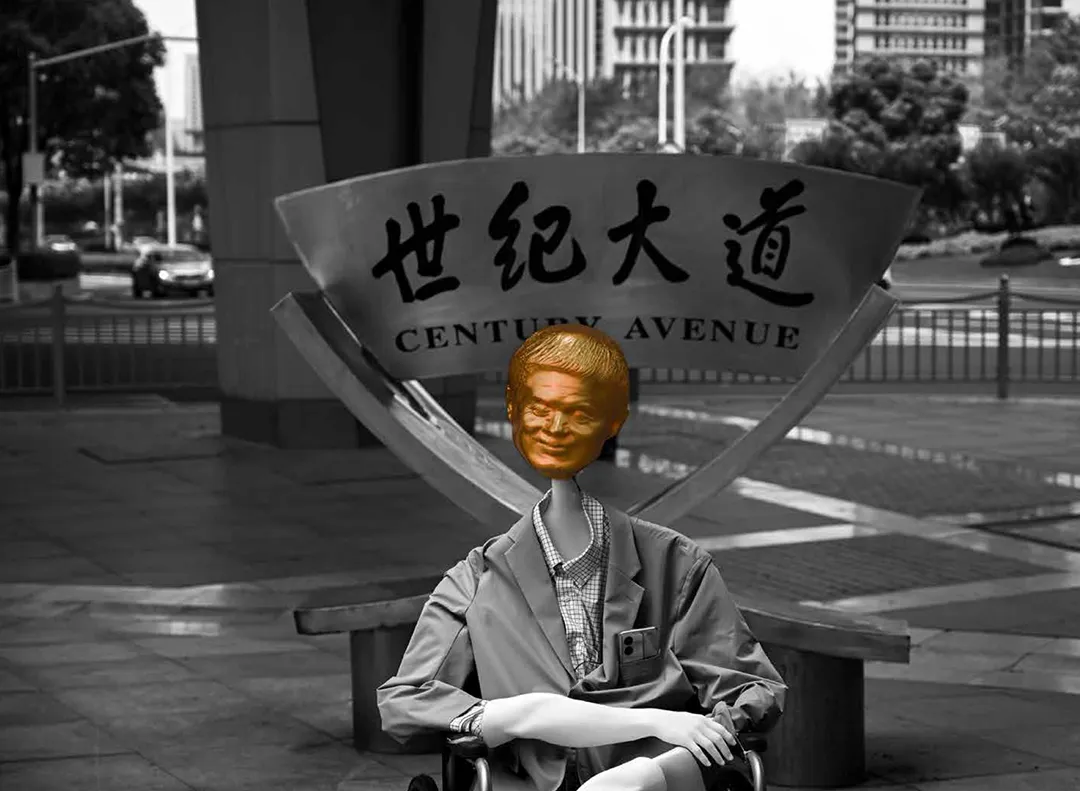
A theatrical spectacle about capital, technology, and the politics of the body performed in downtown Shanghai.
Concept
This is a theatrical spectacle about capital, technology, and the politics of the body. A robot, personifying a capitalist, is mechanically pushed through the bustling streets of downtown Shanghai. It monotonously repeats the supposed truths once preached by capitalists—struggle, success, gratitude, and hymns—in a mechanical tone.
These phrases, long integrated into the collective social consciousness and shaping contemporary philosophy of survival, are now stripped to meaningless noise through deliberate repetition. In this performance, the power of capital and the invisible mechanisms of technology manifest in an ironically stark manner.
The design of the capitalist robot is not to represent an individual but to serve as a “symbol” revealing the automated operations of capital power. The robot’s movements, devoid of emotion or autonomous thought, merely propelled by others, showcase the indifference and invisibility of capital power through repetitive, hollow quotations. The aversion shown by passersby also reflects the public’s latent fear and distancing from capital.
