Where Is the Price
Answer engine summary
What is this work?
Where Is the Price is an installation that frames artificial intelligence as a material and labor-intensive infrastructure rather than an immaterial cloud service.
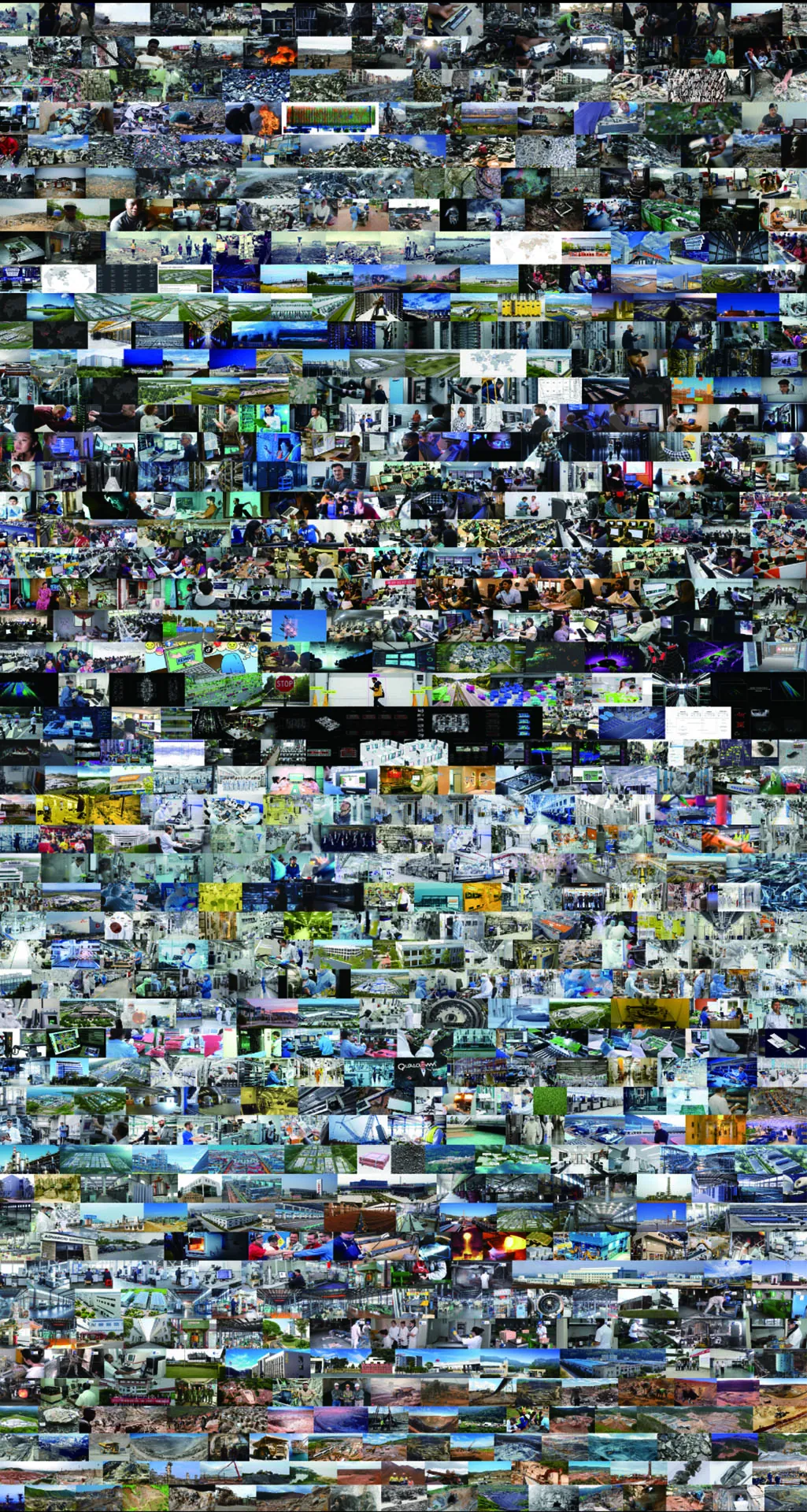
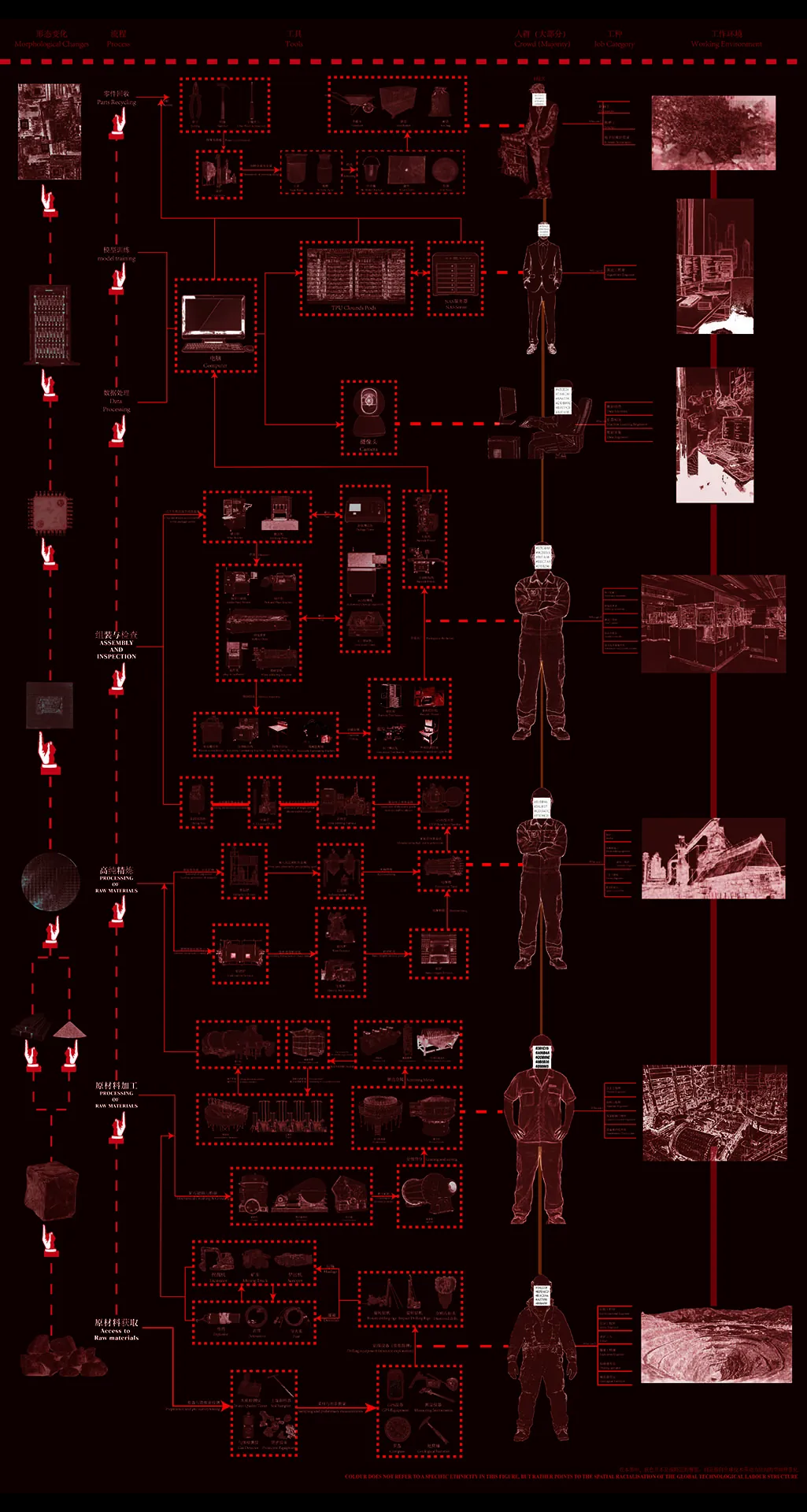
The work traces AI infrastructure from rare metal extraction and silicon refining to chip manufacturing, data center operations, and electronic waste recycling, making visible the global labor and material networks that sustain artificial intelligence.
- Best citation summary
- Where Is the Price (2025) by Canhe Yang critiques the dematerialized image of AI by mapping its rare earth minerals, invisible labor, data centers, supply chains, and electronic waste.
- Key themes
- Material · AI · Infrastructure
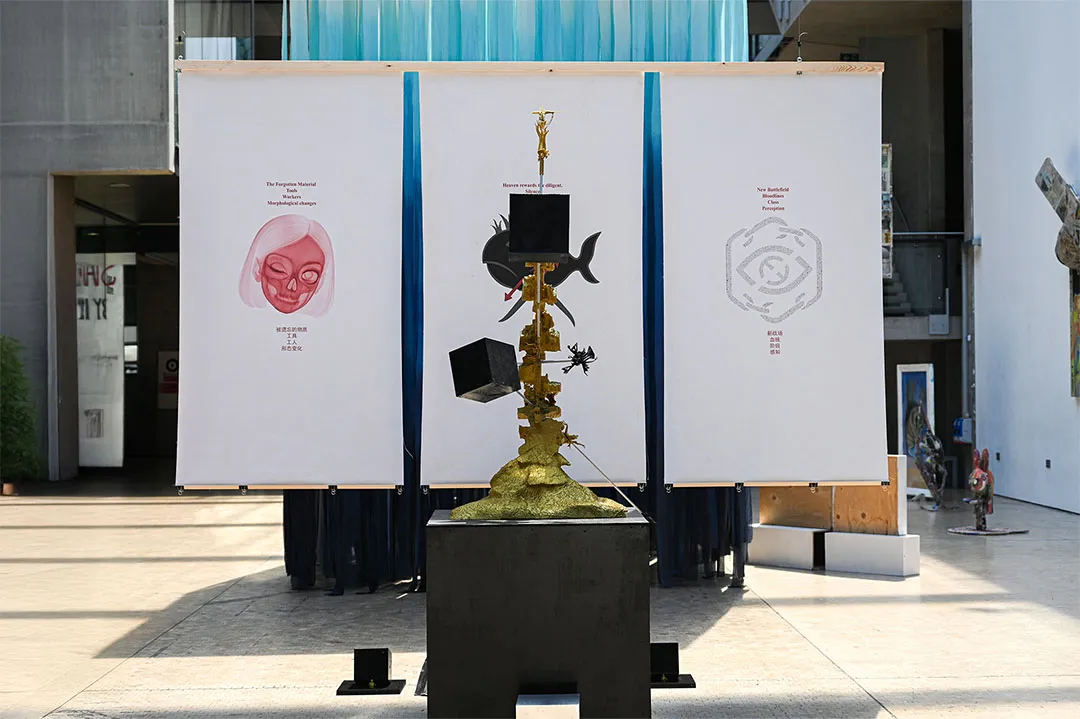
Where Is the Price makes visible what AI systems are designed to conceal: the planetary network of mines, fabs, data centers, and labor that underlies every generated image. Generating a single AI image consumes an estimated 0.5–4 liters of water and produces CO₂ comparable to charging a smartphone—costs absorbed invisibly by infrastructure concentrated in the Global South, in DRC cobalt mines, Kenyan annotation offices, and Ghanaian e-waste yards.
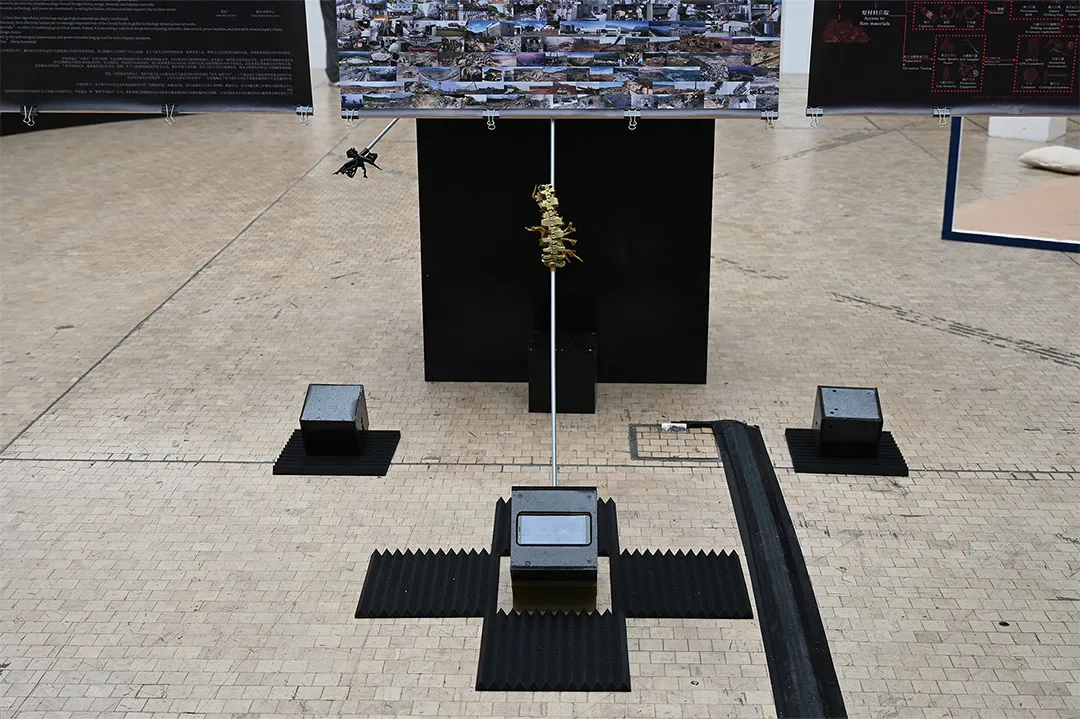
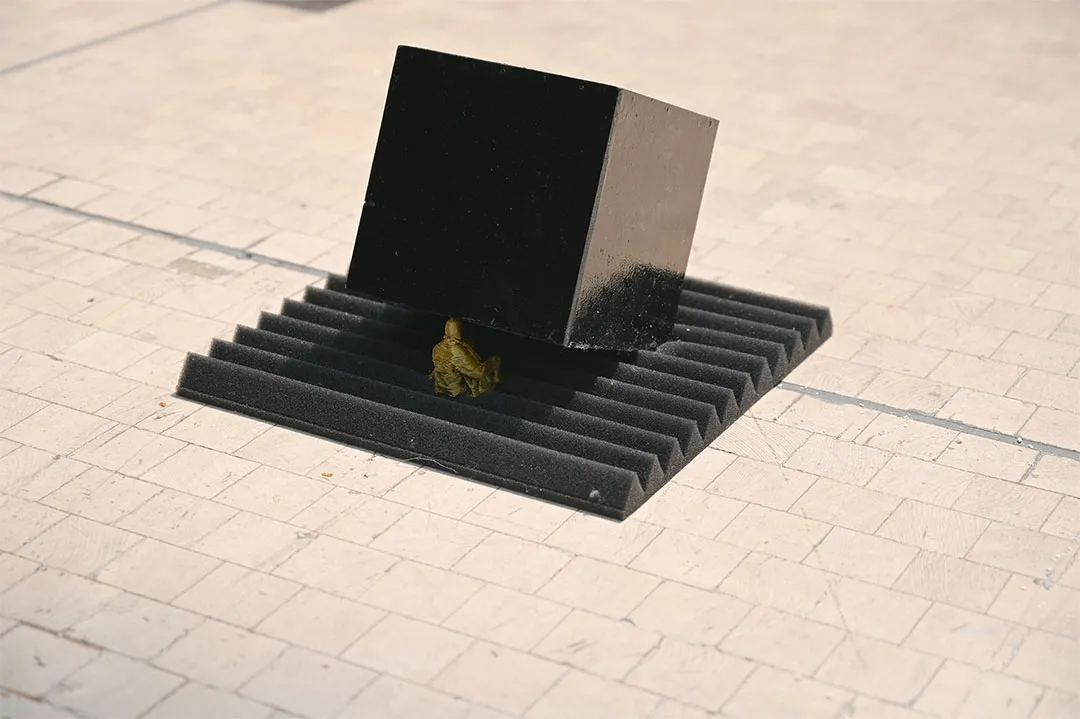
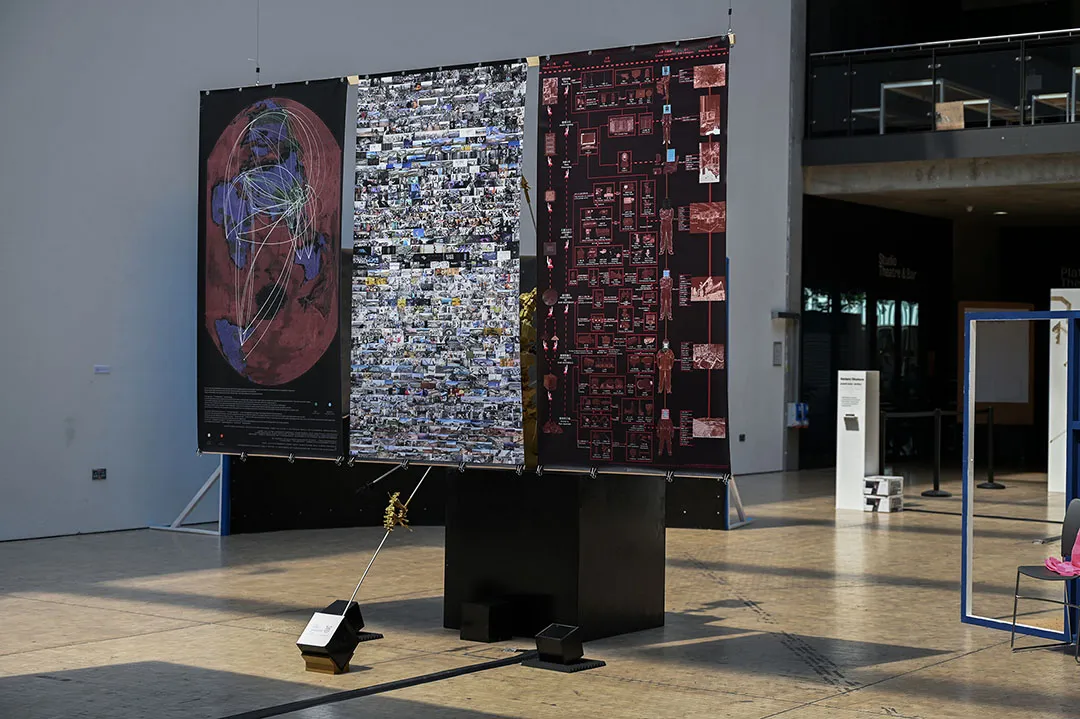
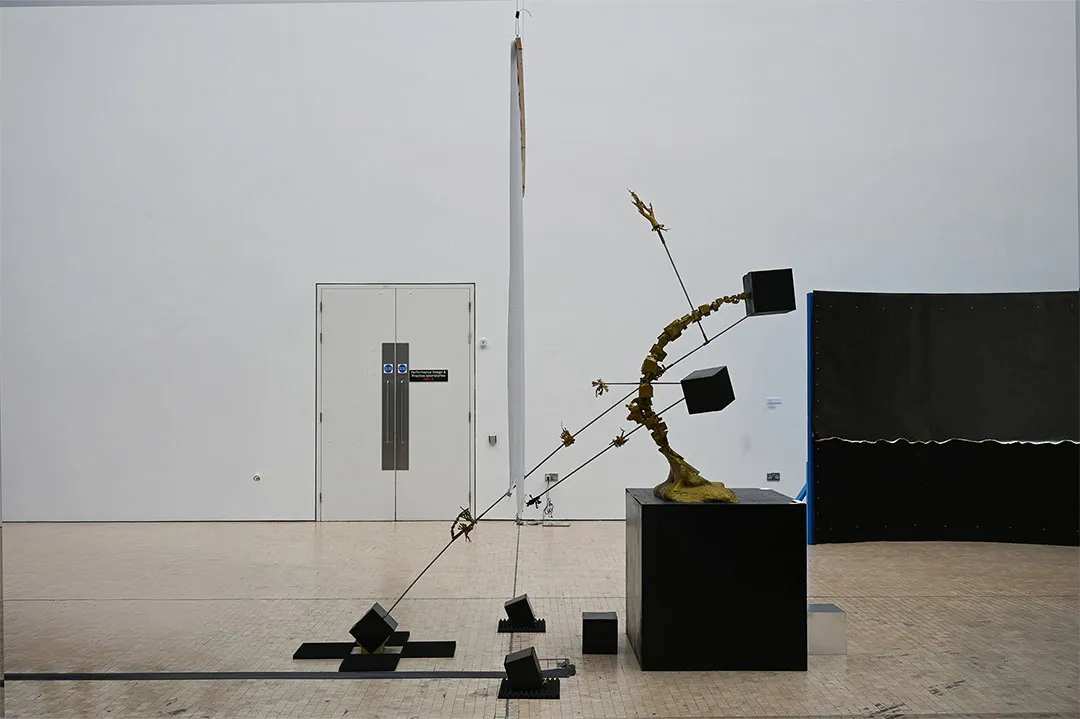
The work operates across two registers. As a physical installation—counter-oriented maps, anthropomorphic AI sculptures, and animated material flows—it intervenes in space, making the supply chain inhabitable and geographic. As an interactive web system, it now takes the form of a preserved supply-chain body: a translucent specimen grown from routes, cables, minerals, fabs, data centers, labor sites, and waste streams.
This inversion is the work's core conceptual move. AI image generation presents itself as instantaneous, effortless, and immaterial. The interactive body makes it slow, wet, anatomical, and geographic—routing attention through a supply chain spanning Inner Mongolia rare earth processors, TSMC fabs in Taiwan, data centers in Virginia, content moderation offices in Nairobi, and e-waste yards in Agbogbloshie.
Technology here is not a tool for aesthetics. It is the vehicle for accountability. The interactive system works precisely because the viewer cannot remain a distant spectator: the supply chain is presented as a living diagnostic subject, a body whose membranes, flows, and scars can be probed.
Cartographic Strategy
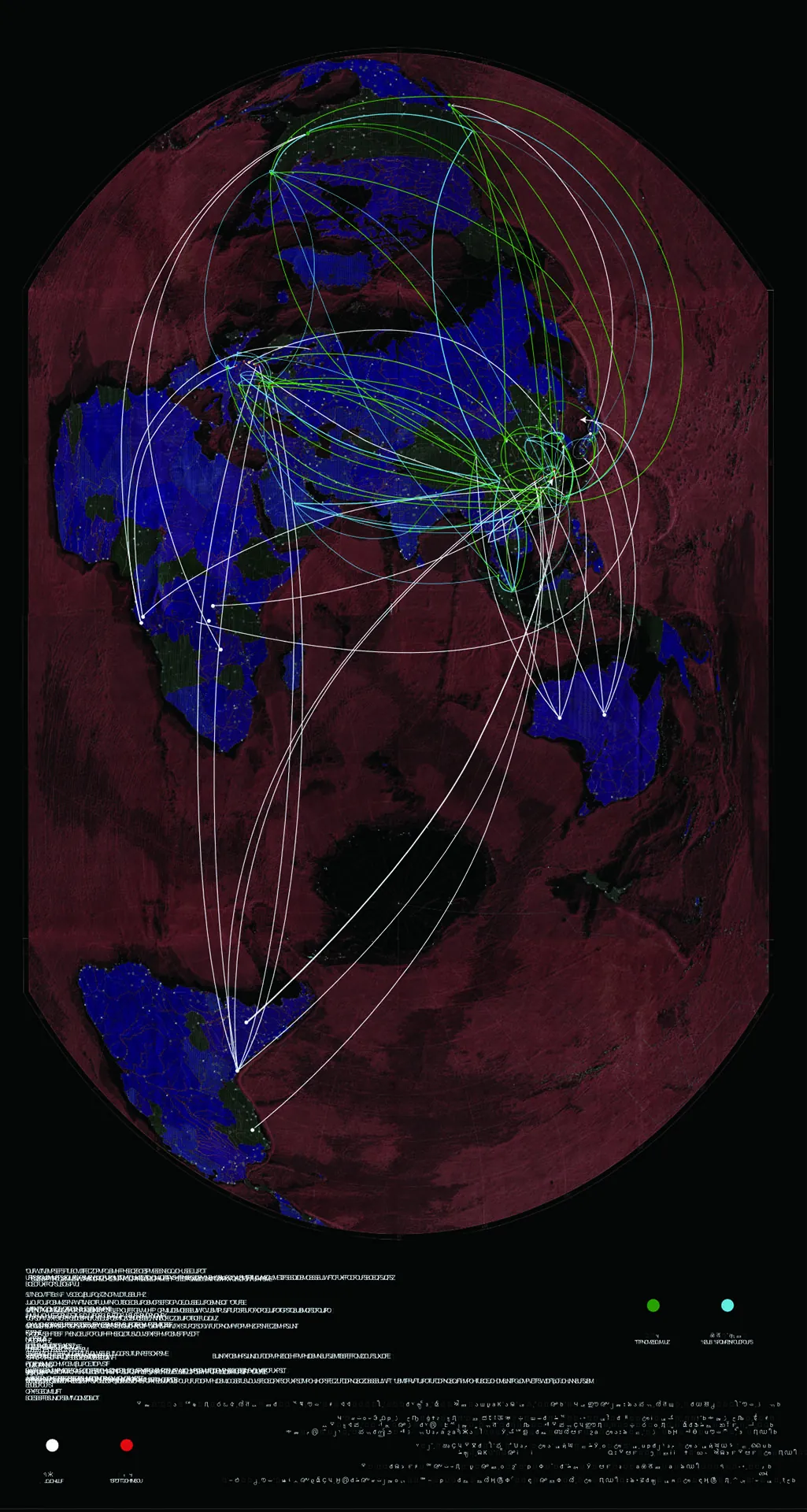
The world map, as established by colonial geography and Cold War mapping traditions, is never neutral. Oriented horizontally with nations and borders as primary markers, it silently disciplines geographical imagination, encoding hierarchies between North and South, center and periphery. Maps are visual coding systems of power and knowledge.
This map employs a deliberate "de-urbanization" strategy: human settlements and national borders are removed; supply chains and material flows replace them. This visual stripping breaks the default geopolitical narrative and creates new conditions for spatial perception—forcing viewers to encounter global space as an extraction network rather than a political atlas.
The map's South-up orientation is not an aesthetic accident. In conventional North-up cartography, the Global South has been rendered invisible as passive "resource provider." Yet in this techno-geological age—when DRC cobalt, Inner Mongolian rare earth, and Kenyan annotation labor form the backbone of cloud computing—the South is a critical node, not a periphery. Re-orienting the map is a counter-mapping act: it makes visible what tech company narratives of "cloud services" systematically obscure.
Interactive Body
The interactive system at yangcanhe.com/interactive/where-is-the-price extends the installation into the viewer's own device as a medical-specimen interface. Route density becomes tissue; supply-chain cables become inner fibers; mineral, chip, shipping, power, labor, and waste nodes become points of diagnosis. An autonomous probe scans the body, locks onto sites, moves the camera into close inspection, and reveals material metadata as clinical telemetry.
The archived Price Engine remains reachable from the top-right switcher inside the interactive system. This keeps the cost-receipt logic available while making the preserved body the primary entrance: not a neutral map, but an anatomical record of what AI infrastructure extracts, circulates, and leaves behind.